
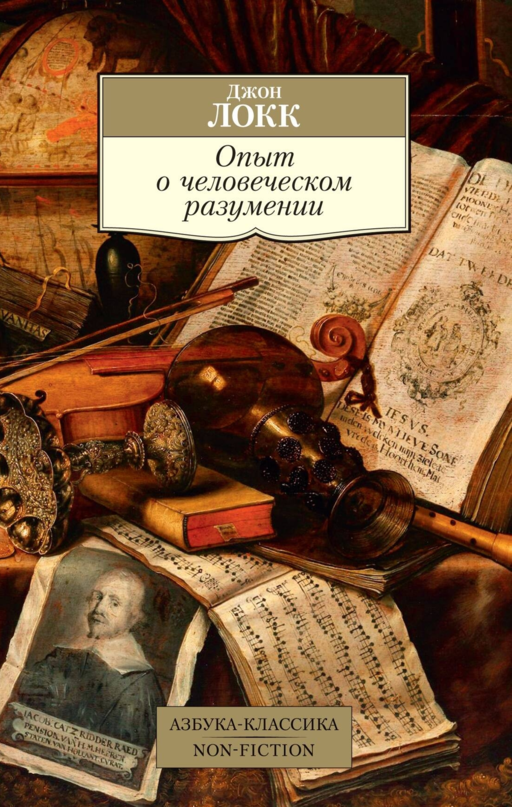
An Essay Concerning Human Understanding
John Locke (1632–1704) — English philosopher, one of the greatest thinkers of the Enlightenment era, "father of liberalism," who influenced epistemology and political philosophy, a consistent supporter of the social contract theory, democratic revolution, and the people's right to overthrow a tyrant, creator of the theory of separation of powers. Locke's ideas were inherited by Voltaire and Jean-Jacques Rousseau, and later influenced Immanuel Kant. Locke’s views are reflected in the text of the US Declaration of Independence, and modern humanistic concepts of basic human rights owe much to him. "An Essay Concerning Human Understanding" is one of John Locke's key works and a central text of empiricism. Here Locke — partly in dialogue with Descartes and Hobbes — refutes rationalists' notions of innate ideas, consistently postulates the primacy of sensation and direct experience over reason, and examines the genesis of ideas linked with feelings, words, and perception. The notions of identity and self, as treated by modern psychology, have their roots largely in Locke's epistemological theory. This work influenced many Enlightenment philosophers, including David Hume; it was vigorously debated by Gottfried Leibniz and George Berkeley. "Many philosophers wrote novels about the soul — but here comes a sage who modestly wrote its history," Voltaire commented on "An Essay Concerning Human Understanding."